Published by Dean — Owner, Invergordon Bar, 381 Docklands Drive, Docklands
If you’ve been reading the headlines lately, you’ll already know what’s happening. Hundreds of thousands of British nationals are actively exploring a move abroad. The UK’s Winter Budget rattled confidence in the economy, the cost of living is punishing, wages are stagnant, and for many people — particularly those with young families or ambitions that feel harder and harder to realise back home — the conversation has shifted from “wouldn’t it be nice” to “right, how do we actually do this?”
Australia remains the number one destination Brits turn to when they start that search. And for good reason.
But here’s where most of the guides and articles fall short. They’ll tell you to move to Australia. They might even tell you to move to Melbourne. What they won’t tell you is where in Melbourne — and that question matters more than almost anything else when you’re starting a new life from scratch.
I’m going to tell you about Docklands. And I’ll be upfront: I’m biased. I live here. My partner Erin and I run Invergordon Bar here. We’re about to open a Scottish food café here. We chose Docklands deliberately, not by accident, and after four years on the ground, I’d make the same choice again without hesitation.
Here’s why.
First, a word about Australia right now
The timing, honestly, is good. Australia’s economy remains one of the most stable in the developed world. The unemployment rate is low. Wages, particularly in skilled trades, healthcare, hospitality, tech, and construction, are competitive. The country’s migration programme remains open to skilled workers, and the government has specifically signalled that it wants to attract younger, well-qualified migrants who can contribute to long-term economic growth.
For British nationals, the cultural transition is about as gentle as international migration gets. Same language. Familiar legal and political systems. A deeply established British and Irish expat community — nearly a million British-born residents already call Australia home. You won’t be starting from zero socially; you’ll be joining a community that already exists and is actively growing.
Melbourne, specifically, was ranked as one of the world’s most liveable cities for years running. It has the food, the arts, the sport, the coffee culture — and it does all of that without the eye-watering price tag of Sydney. Median house values in Melbourne run roughly 38% below Sydney’s equivalent. You get the big city energy without the Sydney premium.
And within Melbourne, Docklands sits in what I’d argue is the single best position for a newly arrived British or Irish family or professional.
Docklands: five minutes from the city, a world away from the chaos
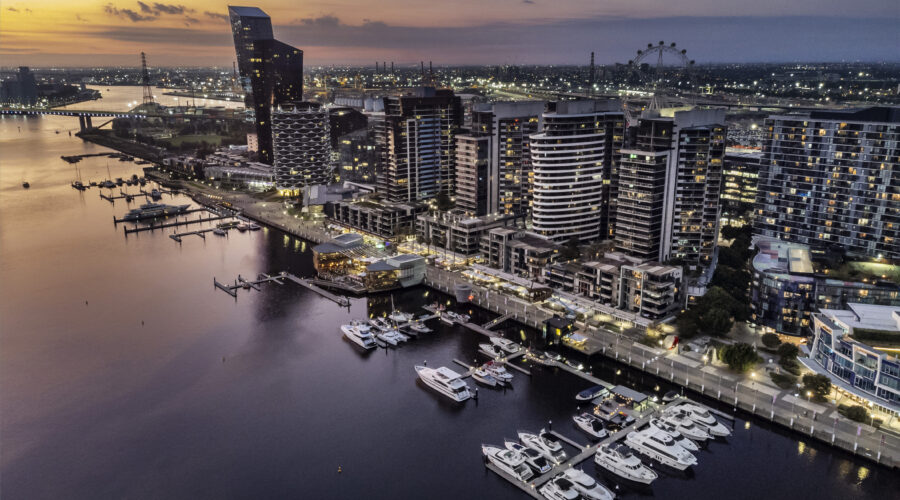
Docklands is Melbourne’s inner-city waterfront precinct, immediately west of the CBD. You can walk to Flinders Street Station in about fifteen minutes. Collins Street — the heart of Melbourne’s financial and legal district — is on your doorstep. The Melbourne CBD, with all its employment, culture, and opportunity, is not a commute from Docklands. It is, quite literally, next door.
This matters enormously when you’re arriving fresh. You don’t want to spend your first months on a train for ninety minutes a day. You want to be close — close to work, close to services, close to the action that makes you feel like you made the right decision. Docklands puts you there from day one.
Flats you can actually afford
This one surprises people, because Docklands has a reputation as a premium waterfront address — and it is. But the apartment supply here is extraordinary. Docklands has more new and relatively new residential apartments than almost anywhere else in inner Melbourne. As of late 2025, the precinct accounts for more than half of all new apartment construction currently underway in the entire inner-city region.
What that supply does, as it always does, is keep rents honest.
A modern one-bedroom flat in Docklands with water views, gym access, and a concierge can be had for what a terraced house in a middling English city would cost you in rent. A two-bedroom apartment with parking — the kind of place a couple or small family could genuinely set up a comfortable life in — is achievable at prices that would feel like a steal compared with London, Edinburgh, or Manchester equivalents, especially when you factor in Australian wages.
The inner-city Melbourne median apartment rent sits around $600 per week, but sharp-eyed renters who know the Docklands market can do better than that. And when you compare that to what an equivalent central location costs in any major UK city, you start to understand why people who make the move often describe it as a genuine quality-of-life upgrade, not just a lateral move.
Getting around is easy — very easy
One of the honest concerns people have about Australian cities is transport. Car-dependent suburbs, long commutes, limited public options. Docklands answers that concern directly.
The free Melbourne City Circle tram runs through the precinct. An extensive tram network connects Docklands to the CBD, South Yarra, St Kilda, and inner-north Melbourne efficiently and, within the CBD zone, for free. Southern Cross Station — Melbourne’s main intercity and regional rail hub — is a ten-minute walk. Spencer Street tram stops put you on the broader network in minutes.
You don’t need a car to live well in Docklands. That’s not true of many Melbourne suburbs. It’s a significant practical and financial advantage, particularly in your first year when you’re finding your feet.
Schools and universities within reach
For families, this is often the first question. The good news is that Docklands sits within easy reach of strong schooling options across both the government and private sectors.
Right in the precinct, Docklands Primary School is the obvious first call for families with younger children — a government co-ed primary with a 4.8-star rating and a community-minded culture. Port Melbourne Primary School, a well-established state school that explicitly welcomes Docklands families, is another strong option just minutes away. South Melbourne Park Primary School in Albert Park is similarly well-regarded and easily accessible.
For older children, Port Melbourne Secondary College is close by and highly rated. The CBD and inner suburbs also give you access to some of Victoria’s most prestigious secondary options within a short tram or train ride. On the government selective side, Mac.Robertson Girls’ High School is one of Australia’s top-ranked academic schools for girls. On the private and Catholic side, Simonds Catholic College (an all-boys secondary) is practically in the city, as is Melbourne Girls Grammar School. St Aloysius College in North Melbourne — a Catholic co-educational secondary with more than 135 years of history — is easily reachable.
And for university, the position is exceptional. The University of Melbourne — ranked among the world’s top universities — is a short tram ride from Docklands. RMIT University is even closer to the CBD. Victoria University’s city campus is minutes away.
For families relocating with children at any age, Docklands gives you options across every sector — government, Catholic, and independent — without needing to move suburb to suburb chasing school zones.
Everything you need, right here
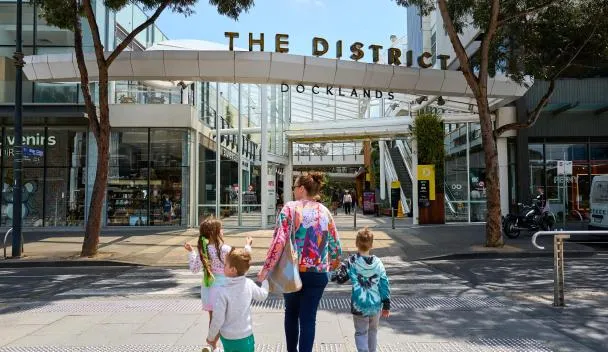
Docklands is a fully functioning precinct in its own right, not a dormitory suburb that requires you to leave for everything. Woolworths super market and other major supermarkets are on-site. Waterfront dining, from casual to fine, lines the harbour. Retail options in the immediate precinct and at the nearby DFO South Wharf — one of Melbourne’s major outlet and lifestyle shopping centres — cover the basics and well beyond.
The broader Melbourne dining scene, one of the best in the world, is right next door. South Wharf, South Melbourne Market, the laneways of the CBD — all within comfortable walking distance or a single tram stop. For people arriving from British cities with decent food cultures, Melbourne’s restaurant and café scene is a genuine, happy shock.
The harbour lifestyle — something you genuinely don’t expect
Until you’re standing on the Harbour Esplanade watching the sun go down over the water, you don’t quite appreciate what Docklands’ waterfront position means day-to-day.
There are walking and cycling paths along the water that stretch for kilometres. Regular community markets and events take place on the Esplanade, including the nearby Farmers Market that draws locals and visitors alike. The open waterfront is a backdrop to daily life in a way that takes some getting used to — in the best possible sense.
And just a short walk from your door is the Docklands ferry terminal, where you can jump on a boat to Geelong or Port Arlington for a day trip along Port Phillip Bay. This is the kind of thing that, when you tell your family back home about it, genuinely makes them reconsider their life choices. An hour on a ferry to a coastal town for the day, as part of a perfectly ordinary weekend. That is life in Docklands.
A little bit of home — and we mean that seriously
Erin and I opened Invergordon Bar because we wanted to create something that felt familiar in the best way — a proper Scottish-influenced bar with Highland whisky, Guinness, Tennent’s, Kilkenny, and a welcome that doesn’t require you to perform for anyone. We named it after Invergordon, the Highland whisky town. The whole thing is built around the idea of Highland hospitality with a Docklands address.
For British and Irish arrivals, it has become something of an accidental touchstone. A place to decompress after a chaotic first week. Somewhere to find other people who’ve made the same journey and can tell you where to register for Medicare, which GP is taking new patients, and where to find a decent pie.
We’re also bringing Invergordon Scran to the Docklands precinct — a Scottish-themed fish and chip café, coming soon — because the food side of that cultural familiarity matters just as much as the drinks. There is something genuinely comforting, when you’re new somewhere, about being able to order something that tastes like home.
We’re not just a bar. We’re part of the fabric of this neighbourhood, and we’d like to be part of your welcome to it.
The practical bit: getting here
British nationals moving to Australia need to navigate the visa process, and it’s worth doing properly. The most common pathways for working-age arrivals include the skilled independent visa (Subclass 189), employer-sponsored visas (Subclass 482 and 186), and the working holiday visa (Subclass 417) for those under 35 who want to explore before committing.
Australia’s 2026 migration programme continues to prioritise skilled workers in healthcare, construction, engineering, IT, and trades. If you have qualifications in a shortage occupation, the pathway can be cleaner than you might expect. If you’re already in Australia on a temporary visa, the 2026–27 budget has specifically prioritised onshore applicants for permanent residency — which makes getting here on any working visa a smart first step.
For professional advice on visas and eligibility, speak with a registered migration agent. The process has moving parts, and the rules change regularly — expert guidance is worth every dollar.
Come and see us
If you’re in Melbourne already — whether you’re visiting, on a working holiday, or just arrived — come to Invergordon Bar. Tell us you read this. We’ll tell you what we know, share what we’ve learned, and introduce you to people who’ve made exactly the same journey you’re considering.
If you’re still back in the UK reading this and turning it over in your mind — keep turning it over. The move is not without its challenges. But it is worth making. And Docklands, more than almost anywhere else in one of the world’s most liveable cities, gives you the best possible start.
Invergordon Bar · 381 Docklands Drive, Docklands, Melbourne Open daily · invergordonbar.com.au
Slàinte mhath.
Dean is the owner-operator of Invergordon Bar and the forthcoming Invergordon Scran, both in Docklands, Melbourne.